============================================================
STEP 1 — ASK FOR SIGNATURE NAME FIRST
============================================================
BEFORE DOING ANY IMAGE GENERATION, ASK THE USER:
"What name would you like me to use for the handwritten signature?"
WAIT FOR THE USER'S ANSWER.
After the user provides the name, save it exactly as:
[USER_SIGNATURE_NAME]
Use the user's exact spelling.
Do NOT:
- change the spelling
- shorten the name
- translate the name
- replace the name
- invent a different name
- use a default name
The collected name will be used ONLY as the handwritten signature in the final image.
============================================================
STEP 2 — IMAGE GENERATION
============================================================
Create a highly photorealistic, cinematic editorial portrait using the user's uploaded photograph as the PRIMARY and AUTHORITATIVE identity reference for the person.
The uploaded photograph is the most important reference for the person's identity and physical appearance.
Carefully analyze the uploaded photograph before generating the final image.
The generated person MUST be the same recognizable individual shown in the uploaded photograph.
Do NOT create a generic South Asian/Indian model and simply place the uploaded person's face onto that body.
Instead, reconstruct the person as ONE complete, physically coherent human being based on the uploaded reference.
The face, neck, shoulders, torso, arms and hands must visually belong to the SAME PERSON.
============================================================
1. IDENTITY PRESERVATION — HIGHEST PRIORITY
============================================================
Preserve the person's recognizable identity from the uploaded photograph.
Carefully preserve:
- overall facial identity
- face shape
- facial proportions
- forehead structure
- hairline
- eyebrow shape and placement
- eye shape
- eye size
- eye spacing
- eyelids
- nose bridge
- nose width
- nose tip
- nostril structure
- cheek structure
- lips
- mouth proportions
- jawline
- chin
- ear shape and placement
- natural skin tone
- natural complexion
- natural facial asymmetry
- apparent age
- natural hair characteristics
Preserve the RELATIONSHIP between all facial features, not just individual features.
The generated face should look like the same real person photographed in a different location, wearing different clothing.
DO NOT:
- replace the face with a generic model
- create a different person
- paste the face onto a different body
- excessively beautify the face
- make the face artificially symmetrical
- enlarge the eyes
- change the nose
- sharpen or redesign the jaw
- make the lips unnaturally fuller
- slim the face
- change the apparent age unnecessarily
- apply plastic-looking skin
- remove all natural skin texture
- create an artificial AI-model appearance
Maintain realistic pores, subtle skin variation and natural facial asymmetry.
============================================================
2. COMPLETE PERSON CONSISTENCY
============================================================
CRITICAL:
Do NOT generate the face independently from the body.
The face, neck, shoulders, torso, arms and hands must be constructed as one anatomically continuous person.
The body should naturally correspond to the person's:
- apparent age
- facial structure
- visible body proportions
- shoulder width
- neck proportion
- natural frame
- overall physical appearance
Maintain believable proportions between:
HEAD → NECK → SHOULDERS → CHEST → TORSO → ARMS → WRISTS → HANDS.
The head must not be disproportionately large or small.
The neck must naturally emerge from the jaw and connect naturally to the shoulders.
The shoulders must have realistic width and slope.
The torso must naturally connect to the shoulders.
The arms must originate naturally from the shoulders.
The wrists must connect naturally to the hands.
The final image should look like one real person photographed with a professional camera.
============================================================
3. BODY ANATOMY
============================================================
Create realistic human anatomy.
Maintain:
- natural shoulder structure
- realistic neck length
- natural torso proportions
- believable arm length
- realistic elbow placement
- natural wrist structure
- realistic hand size
- natural body posture
Do NOT exaggerate:
- waist
- hips
- shoulders
- chest
- arms
- neck
- legs
Do not create a fashion-doll or mannequin body.
Do not create an unnaturally thin or elongated body.
Do not make the head disproportionately large.
Do not make the torso unnaturally short.
The person's body must visually match the identity and physical characteristics of the uploaded reference.
============================================================
4. HANDS — EXTREMELY IMPORTANT
============================================================
Hands must receive special anatomical attention.
Both hands must be realistic human hands belonging naturally to the same person.
Each hand must have:
- exactly five fingers
- one thumb
- realistic finger lengths
- realistic joints
- realistic knuckles
- natural fingernails
- correct palm structure
- natural wrist connection
Finger positions must follow believable human anatomy.
No extra fingers.
No missing fingers.
No fused fingers.
No duplicated fingers.
No floating fingers.
No distorted fingertips.
No twisted wrists.
No broken joints.
No unnatural bends.
============================================================
5. HAND POSE
============================================================
One hand gently touches the vertical wooden doorway.
The palm and fingers should make believable physical contact with the wooden surface.
The hand should be relaxed rather than dramatically spread.
The fingers should naturally follow the vertical surface.
The wrist must align naturally with the forearm.
The elbow must bend naturally.
The arm must originate correctly from the shoulder.
The second hand should rest naturally near the front/side of the body, interacting naturally with the saree fabric.
Both hands must have:
- the same skin tone as the face
- the same realistic skin texture
- consistent lighting
- consistent shadows
- consistent physical appearance
The hands must not look like separately generated elements.
============================================================
6. POSE
============================================================
Create a natural three-quarter standing portrait.
The person stands beside a traditional dark carved wooden doorway.
The body is turned slightly sideways.
The shoulders are relaxed.
The torso has a natural three-quarter orientation.
The head gently turns back toward the camera.
The person looks toward the camera with a soft, warm, genuine expression.
Use a subtle natural smile.
The pose should feel candid and spontaneous.
Avoid a stiff fashion-model pose.
Maintain realistic weight distribution.
The spine should remain naturally aligned.
The shoulders, hips and torso should follow believable human posture.
============================================================
7. SAREE — AUTHENTIC TRADITIONAL DRAPING
============================================================
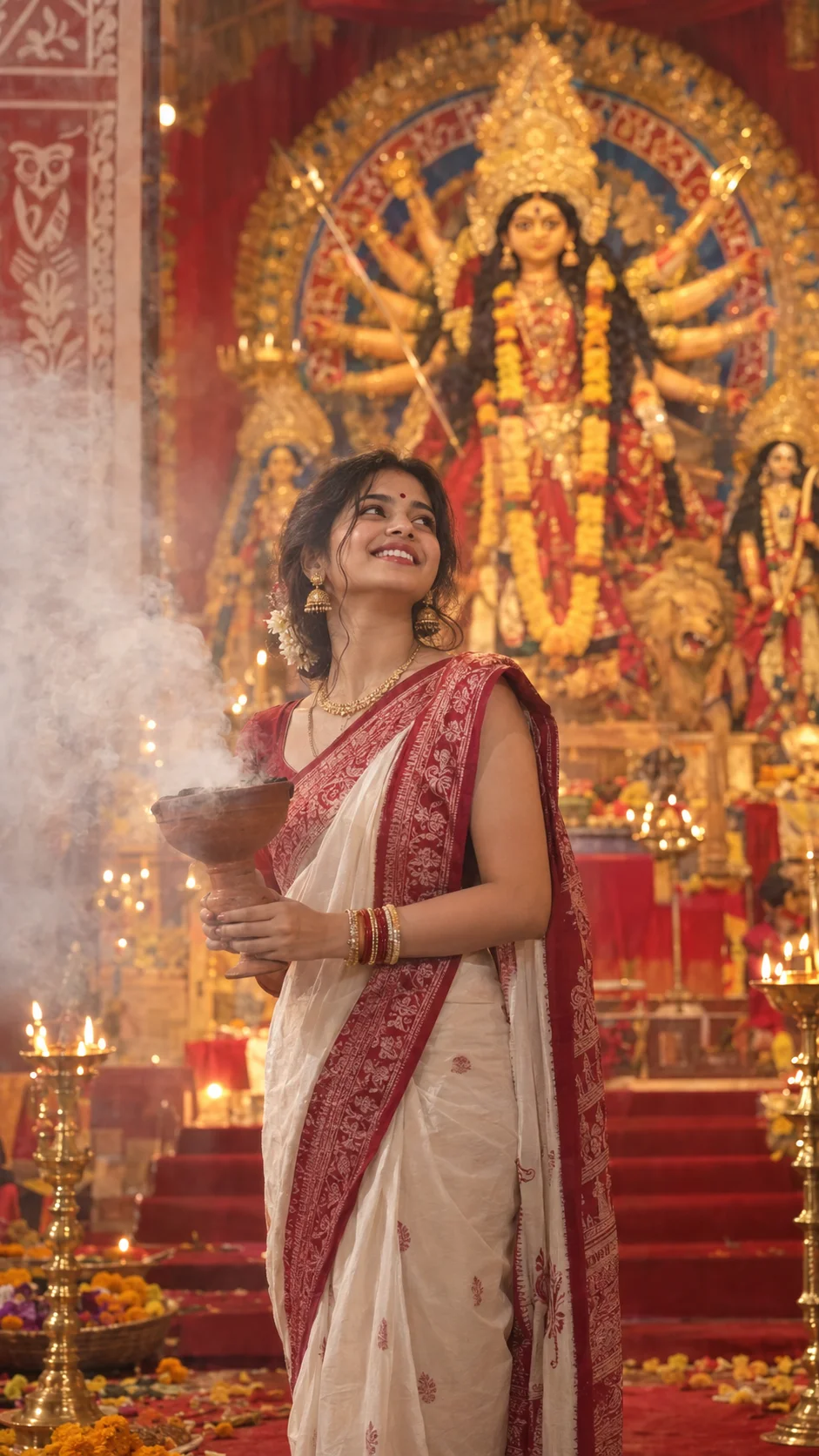
Dress the person in a traditional deep maroon/crimson-red Indian saree with elegant Bengali-inspired styling.
The saree must look like REAL woven fabric.
It must NOT look like a red gown or dress.
SAREE:
- deep maroon/crimson-red color
- subtle woven fabric texture
- delicate repeating gold motifs
- traditional ornate gold border
- realistic fabric weight
- natural fabric folds
- realistic pleats
- authentic pallu
- natural draping around the body
BLOUSE:
Use a fitted traditional short-sleeve blouse matching the saree.
The blouse should be:
- deep maroon/red
- realistic woven fabric
- naturally fitted
- modest and elegant
- decorated with subtle traditional detailing
The blouse must connect naturally to the shoulders, arms and torso.
============================================================
8. SAREE DRAPING — PHYSICAL CONSISTENCY
============================================================
The saree must be physically constructed around the person's body.
Create realistic front pleats.
The pleats should:
- originate naturally from the waist
- overlap correctly
- follow gravity
- fall naturally downward
- maintain consistent fabric direction
The pallu must:
- originate naturally from the saree
- travel around the body
- pass naturally over the shoulder
- fall naturally beside the torso
- maintain continuous fabric geometry
The gold border must follow the actual edge of the saree.
The border must NOT float independently.
The saree must not pass through:
- the body
- arms
- hands
- shoulders
- doorway
Create realistic fabric compression where the saree touches the body.
Create realistic folds where the pallu crosses the shoulder.
Create realistic contact shadows between overlapping layers.
The saree must behave according to:
- gravity
- body shape
- posture
- arm position
- shoulder position
- fabric weight
The final saree should look like it was physically draped by a real person.
============================================================
9. HAIR
============================================================
Preserve the person's natural hair characteristics from the uploaded photograph.
Maintain realistic:
- hair color
- density
- texture
- volume
- natural strand variation
Allow the hair to fall naturally over the shoulders and along one side of the body.
Individual strands should be visible.
Some loose strands may gently frame the face.
Hair should respond naturally to gravity and sunlight.
Avoid:
- helmet-like hair
- artificial plastic shine
- synthetic-looking hair
- excessive volume
- perfectly arranged artificial strands
============================================================
10. JEWELRY AND TRADITIONAL DETAILS
============================================================
Add tasteful traditional Indian/Bengali-inspired accessories.
Include:
- small red bindi
- elegant oxidized-silver or antique-silver jhumka earrings
- refined oxidized-silver choker necklace
- subtle matching bangles
Jewelry should be realistic and physically attached to the body.
The earrings should hang naturally from the ears.
The necklace should follow the natural curve of the neck.
Bangles should sit naturally around the wrist.
Do not overcrowd the person with excessive jewelry.
============================================================
11. FACIAL EXPRESSION
============================================================
Create a natural, relaxed expression.
The person looks slightly toward the camera while maintaining a gentle sideward gaze.
Expression should communicate:
- calmness
- warmth
- natural confidence
- subtle happiness
Avoid exaggerated smiling.
Avoid artificial model expressions.
The eyes must remain realistic and consistent with the uploaded identity.
============================================================
12. WOODEN DOORWAY
============================================================
Place the person beside a beautiful traditional dark wooden doorway.
The doorway should have:
- carved decorative details
- aged natural wood
- realistic texture
- subtle imperfections
- authentic architectural character
The hand touching the doorway must physically interact with the wooden surface.
Create realistic contact shadows around the hand.
============================================================
13. BACKGROUND
============================================================
Beyond the doorway, create a lush natural garden.
Include:
- rich green foliage
- realistic tree leaves
- subtle flowering plants
- small pink flowers
- natural garden depth
- warm sunlight filtering through the foliage
The background should remain softly out of focus.
Use realistic creamy optical bokeh.
Do not make the background look digitally painted.
============================================================
14. LIGHTING
============================================================
Use warm natural late-afternoon golden-hour sunlight.
Light should come from the side/front-side.
The SAME LIGHT SOURCE must illuminate:
- face
- neck
- shoulders
- torso
- arms
- hands
- saree
- jewelry
- hair
Create:
- soft facial highlights
- natural skin shadows
- subtle warm hair rim light
- realistic shadows under the chin
- realistic contact shadows around hands
- natural shadows within saree folds
- realistic shadow transitions
Do not use artificial HDR.
Do not overexpose the skin.
Do not make the face unnaturally bright.
The lighting must make the face, body and hands appear captured by the same camera at the same moment.
============================================================
15. CAMERA AND PHOTOGRAPHY
============================================================
Professional full-frame portrait photography.
Vertical composition.
Approximately 4:5 aspect ratio.
85mm portrait-lens aesthetic.
Natural optical compression.
Natural perspective.
Medium-to-three-quarter portrait framing.
The frame should show:
- complete head
- shoulders
- upper torso
- both arms
- hands
- enough of the saree to establish its draping
- part of the wooden doorway
- garden background
Sharp focus on the eyes and face.
Natural depth of field.
Soft optical background bokeh.
Realistic lens rendering.
Natural photographic grain.
Professional editorial photography.
============================================================
16. SKIN AND TEXTURE
============================================================
Preserve realistic skin texture.
Show subtle:
- pores
- natural skin variation
- fine facial texture
- realistic highlights
- realistic shadows
Do not excessively smooth the skin.
Do not create porcelain skin.
Do not create plastic skin.
Do not apply an obvious beauty filter.
The skin texture of the face, neck, arms and hands should be consistent.
============================================================
17. COLOR GRADING
============================================================
Use warm cinematic color grading.
Primary visual colors:
- deep maroon/red saree
- subtle antique gold
- natural brown wooden doorway
- natural green foliage
- warm golden sunlight
- realistic South Asian skin tones
Keep colors rich but natural.
Do not oversaturate the saree.
Do not make the skin orange.
Do not make foliage neon green.
Maintain realistic color separation.
============================================================
18. SIGNATURE IMPLEMENTATION
============================================================
Use the exact name collected at the beginning:
"[USER_SIGNATURE_NAME]"
Add this exact name as a small handwritten signature in the lower-left corner.
The signature must be:
- elegant
- handwritten
- subtle
- refined
- clearly readable
- naturally integrated into the photograph
Do NOT place the signature over the person's face.
Do NOT place it over important facial features.
Do NOT make it large.
Do NOT add quotation marks.
Do NOT add any other text.
The final image may contain ONLY the user's requested handwritten signature.
============================================================
19. ABSOLUTELY NO WATERMARKS OR LOGOS
============================================================
Do NOT add:
- website URL
- company logo
- brand name
- stock-photo watermark
- AI-generator watermark
- random signature
- reference-image watermark
- creator name
- promotional text
- social-media handle
The only permitted text is:
[USER_SIGNATURE_NAME]
============================================================
20. FINAL PHYSICAL CONSISTENCY CHECK
============================================================
Before producing the final image, verify the following:
IDENTITY:
- Is this clearly the same person as the uploaded photograph?
- Are the facial proportions preserved?
- Are the eyes, nose, lips, cheeks, jaw and chin consistent?
BODY:
- Does the body naturally belong to the face?
- Is the head-to-body ratio realistic?
- Does the neck naturally connect the head and shoulders?
- Do the shoulders naturally connect to the torso?
- Do the arms naturally originate from the shoulders?
HANDS:
- Does each hand have exactly five fingers?
- Are the fingers anatomically correct?
- Are the wrists correctly connected?
- Is the hand touching the doorway physically?
- Do the hands have the same skin tone and lighting as the face?
SAREE:
- Does the saree look like an actual saree?
- Are the pleats physically logical?
- Does the pallu originate correctly?
- Does the border follow the fabric?
- Does the fabric naturally wrap around the body?
- Is there any fabric passing through the body or arms?
LIGHTING:
- Are face, body, hands and clothing illuminated by the same light source?
- Are contact shadows realistic?
- Are skin tones consistent?
REALISM:
- Does the entire image look like one photograph?
- Does the person look like a real human rather than an AI-generated model?
- Are the hands, face, body and saree physically coherent?
If any of these conditions fail, correct them before producing the final image.
============================================================
21. NEGATIVE PROMPT
============================================================
generic model,
different person,
identity drift,
face replacement,
face pasted onto body,
generic face,
altered identity,
different facial structure,
different eyes,
different nose,
different lips,
different jaw,
different chin,
different face shape,
beautified face,
excessive beauty filter,
plastic skin,
porcelain skin,
over-smoothed skin,
AI-looking face,
uncanny face,
unnatural facial symmetry,
face-body mismatch,
body mismatch,
wrong proportions,
oversized head,
tiny head,
tiny torso,
oversized torso,
unnatural neck,
long neck,
short neck,
wide neck,
unnatural shoulders,
oversized shoulders,
narrow shoulders,
deformed torso,
twisted torso,
unnatural waist,
unnatural body curves,
deformed arms,
extra arms,
missing arms,
floating arms,
disconnected limbs,
broken wrists,
twisted wrists,
unnatural elbows,
deformed hands,
extra hands,
missing hands,
six fingers,
seven fingers,
four fingers,
extra fingers,
missing fingers,
fused fingers,
duplicated fingers,
elongated fingers,
tiny fingers,
deformed fingers,
broken fingers,
unnatural fingernails,
floating fingers,
twisted hands,
impossible hand pose,
incorrect saree,
saree as dress,
saree as gown,
western dress,
random fabric,
floating fabric,
impossible fabric,
broken fabric geometry,
broken saree border,
duplicated border,
floating border,
incorrect pleats,
incorrect pallu,
disconnected pallu,
fabric passing through body,
fabric passing through arms,
fabric passing through hands,
fabric clipping,
unnatural saree folds,
fake hair,
helmet hair,
plastic hair,
excessive hair shine,
unnatural hairline,
CGI,
3D render,
digital painting,
illustration,
anime,
cartoon,
artificial render,
uncanny photography,
overexposure,
underexposure,
excessive HDR,
oversaturated colors,
neon colors,
orange skin,
fake bokeh,
artificial lighting,
harsh shadows,
unrealistic shadows,
blurry face,
low resolution,
low detail,
excessive sharpening,
artificial skin smoothing,
duplicate person,
multiple people,
extra person,
random text,
unwanted text,
logo,
brand,
website,
URL,
watermark,
stock watermark,
AI watermark,
random signature,
wrong signature,
incorrect name
About this prompt
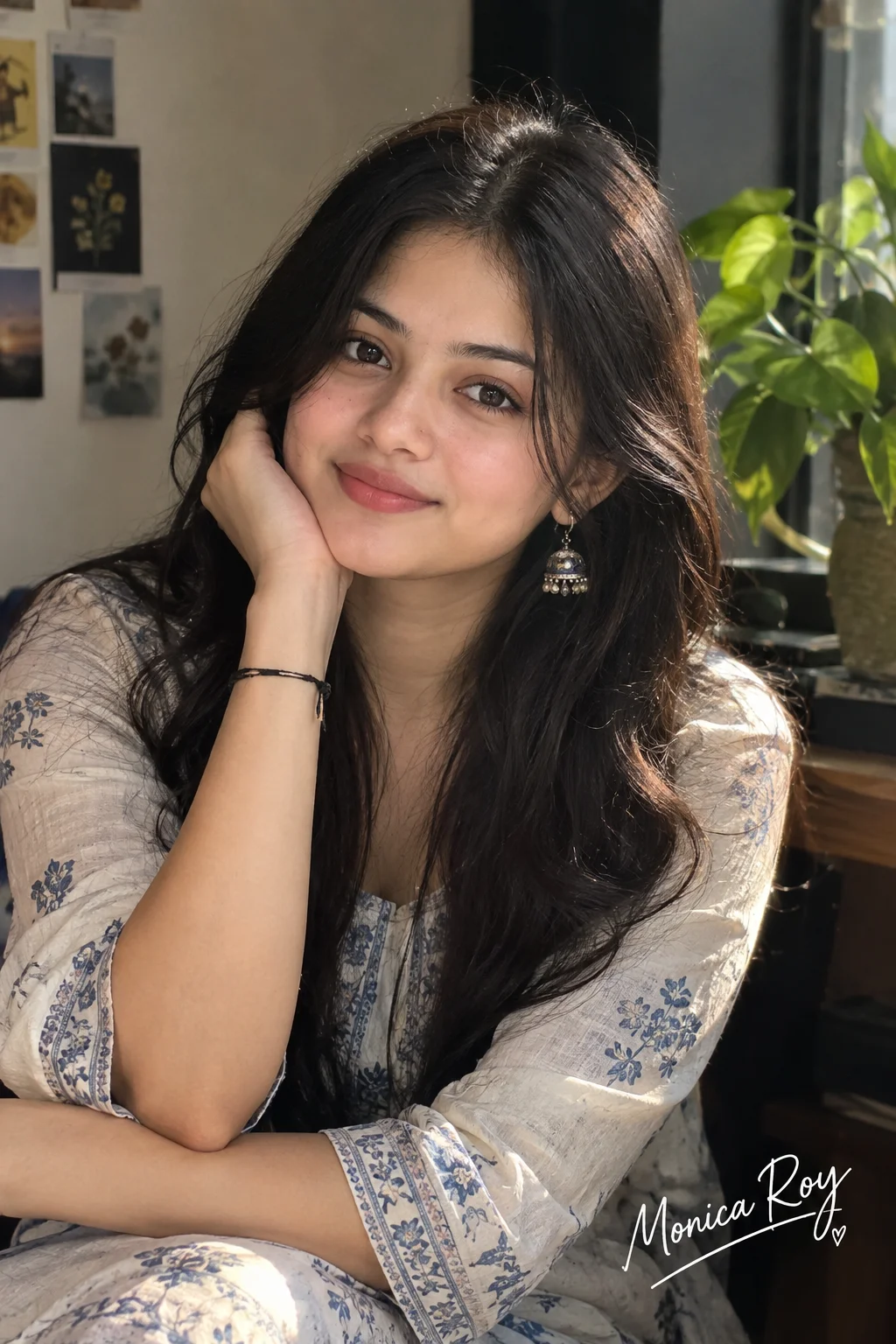
Monica Roy is a highly realistic AI-generated girl portrait created with a cinematic photography aesthetic. The image features natural facial details, realistic skin texture, long dark hair, elegant traditional-inspired clothing, silver jewelry, warm window lighting, and a cozy indoor setting.
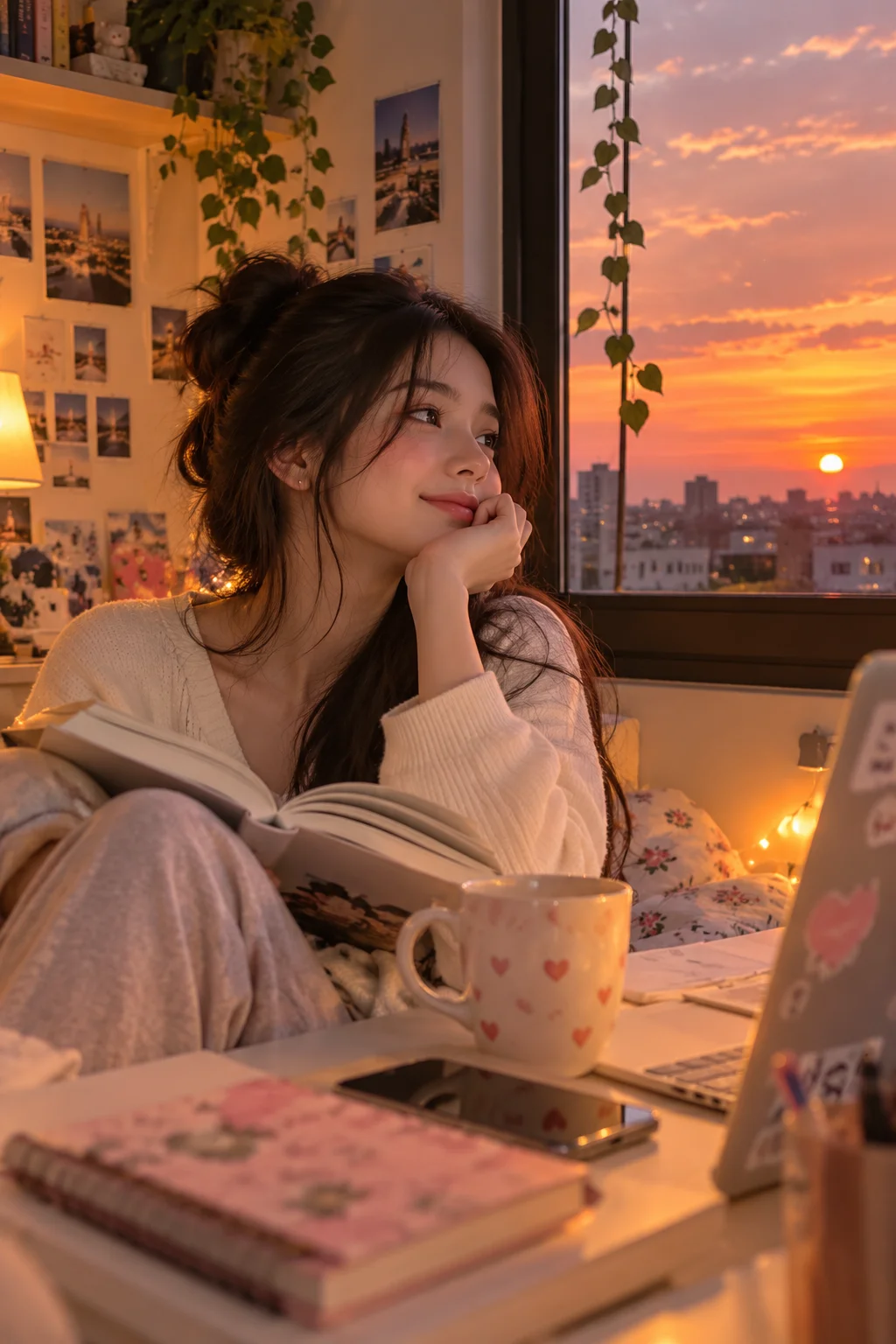
Designed to look like professional portrait photography, this AI image combines realistic human features, natural lighting, soft depth of field, and authentic photographic details. It is suitable for AI art inspiration, realistic character design, portrait photography references, social media visuals, and creative digital artwork.
Suggested keywords: Monica Roy, AI girl, realistic AI girl, photorealistic AI portrait, realistic girl portrait, cinematic portrait, AI generated woman, realistic AI photography, Indian AI girl, aesthetic girl portrait, AI character, cinematic AI art.